

“The Life of Pi,” Review and Criticisms (Spoiler Alert)

A few weeks ago, I finally watched the Academy Award winning film, “Life of Pi.” No doubt the film was well-made, exciting, and beautifully done. However, something bothered me about the film; I wasn’t quite sure what point the filmmakers were trying to make about God. To be honest, I had to watch it twice to really get it. Upon watching it a second (and less distracted) time, I heard the line, “And so it goes with God,” and I said, “Oh, that’s what they were saying!”
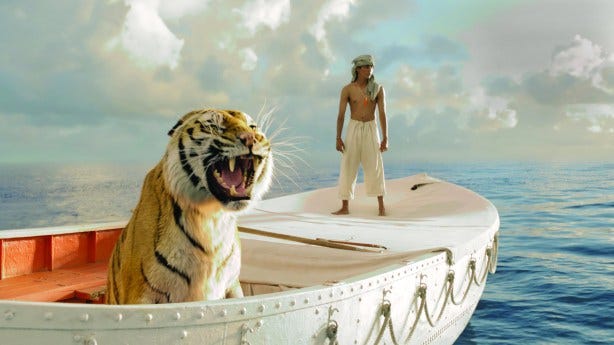
“Life of Pi” is so much more than an adventure movie about a shipwrecked boy, stuck on a lifeboat with a tiger; if it had just been that, I would have thoroughly enjoyed it. However, “Life of Pi” is meant to make statements about faith, religion, and God. They are statements many in our culture will applaud because Pi personifies their theology and worldview.
Synopsis (Spoiler Alert!):
The movie is about a man, named Pi, who is relating his life’s story to a novelist. The novelist was intrigued by the story because he was promised it would make him believe in God. Pi tells the novelist how, beginning in childhood, his faith developed. He tells of how he was first “introduced to God” through Hinduism, then through Catholicism, and finally through Islam.
But, the main story centers around Pi’s voyage across the Pacific Ocean. During the voyage, the ship on which Pi (a teenager at the time) and his family were traveling, sank in the ocean. Pi tells the novelist that he and a few animals were the only ones who managed to escape on a lifeboat. Soon after the shipwreck, most of the animals killed one another, leaving Pi alone at sea with an adult Bengal Tiger named Richard Parker.
Pi and Richard Parker survive their ordeal, washing up on the shores of Mexico. Pi relates his story to the officials in Mexico. They, of course, find the story hard to believe. So, Pi tells them another story to explain what happened at sea. This story is void of any animals. Instead, the lifeboat is full of people. The people in the boat eventually kill one another, leaving Pi alone at sea.
Near the end of the film, Pi says to the novelist, “I’ve told you two stories about what happened out on the ocean. Neither explains what caused the sinking of the ship, and no one can prove which story is true and which is not. In both stories, the ship sinks, my family dies, and I suffer…So which story do you prefer?”
The novelist admits that he prefers the story with the tiger. “That’s the better story,” he says. Pi smiles slyly and says, “And so it goes with God.”
In case you’re like me, and you find the meaning somewhat hidden, let me explain some of the theological points I believe the filmmakers are trying to make:
1. Religions are all just different ways to get to know God.
In the movie, Pi is a Catholic-Hindu-Muslim (who also teaches classes on Judaism). In our culture, Pi would be the poster child for the way religion “should be.” The world believes Christianity, Hinduism, Islam, Judaism, etc. should simply be seen as different paths, leading to the same place – God. They believe we should accept every path as an equally valid means of reaching God.
Pi’s father, a harsh atheist, admonishes Pi to stop trying to follow every religion at once. He encourages him to use reason and logic to choose a single path. Pi’s father says, “Believing in everything at once is the same as believing in nothing.” He was exactly right; but unfortunately, the filmmakers used the father’s character to lead the audience to the impression that reason and logic are the tools of the atheist. The filmmakers seem to suggest that having faith is a matter of abandoning reason and logic.
The idea that every religion leads to God is a philosophy conjured up by those who know nothing of the religions about which they speak. They miss the point that every religion – not just Christianity – is mutually exclusive. If one is true, the others simply cannot be true. Even Hinduism (in which worshipers believe in millions of gods), if it is true, then monotheistic religions (Judaism, Christianity, Islam) cannot be true. Likewise, if Judaism, Islam, or Hinduism is true, then Jesus is not the Christ and Christians have no hope. But, if Jesus is the Christ, then He is the ONLY path to the Father (John 14:6) and every other religion is false.
2. Believing in God is just believing in a “better story.”
The main point of the story is that suffering, pain, and loss are realities with which humans must learn to cope. Pi told two stories; both involving suffering, pain, and loss. The first story was magical, fanciful, and hard-to-believe. The second story was much more logical, reasonable, and easy to believe. As Pi said, “[either way] the ship sinks, my family dies, and I suffer…So which story do you prefer?”
Faith, in this movie, is about simply preferring to see God. The world considers believers to be child-like; still daring to believe in the unbelievable, in order to cope with the pain of life. They see believing in God as something people do in spite of reason, logic, and science. This movie is their way of saying, “God is a fun fantasy in which to believe. It’s probably all just a fairy tale, but if it helps you deal with your suffering, go ahead and believe in Him.”
However, that is not the biblical definition of “faith.” Faith is not just simply preferring to believe in God because He is the “better story.” Faith is founded, not in wishful thinking, but in reality and in truth (Romans 1:20; 10:17). The Hebrew writer says, “Faith is the assurance of things hoped for, the conviction of things not seen” (Hebrews 11:1). Faith is having confidence in an unseen God. I would encourage you to read a post I wrote entitled, “God – The Missing Piece of the Puzzle.”
3. Truth is irrelevant.
Probably the most concerning thing about this movie is the idea that truth is irrelevant. Pi said, “I’ve told you two stories about what happened out on the ocean…no one can prove which story is true and which is not…So, which story do you prefer?” He didn’t ask, “Which story do you believe is true?” He might as well have said, “It doesn’t really matter which one is true.”
Instead, Pi simply asked, “Which story do you prefer?” In today’s culture, it doesn’t matter if what you believe is true; it only matters that you truly prefer what you believe.
To many, there is no such thing as “truth.” There is only what is true for you and what is true for me. Life is simply about choosing the “truth” you prefer. What a dangerous and ignorant way of thinking! Even in the movie, both stories could not be true. At least one of the stories was a boldface lie. To “prefer” a lie over the truth, is ignorant, foolish, and dangerous. Especially, when your soul is at stake.
Jesus said He is the truth (John 14:6), He said truth sets men free (John 8:32), and He said God’s word is truth (John 17:17). Truth is not based in wishful thinking, but upon facts. I believe in God, not because it makes it easier to deal with suffering, but because the facts have convinced me of His existence and the reliability of His word.
Although it was certainly an entertaining film, it ought to be a film which offends Christians deeply. It is condescending to its core to suggest that faith is simply a blind belief in a fairy tale.
But maybe I just over-think things. What did you think of the movie?
I love you and God loves you,

The post “The Life of Pi,” Review and Criticisms (Spoiler Alert) appeared first on Radically Christian.
The Sixth Media Key: Skillfully Created
Winning two Golden Globes and four Academy Awards the movie was clearly masterfully created. The use of special effects, CGI, and brilliant cinematography orchestrated the qualities of story telling in this harrowing tale of survival and faith. The quality of the media was so important as to not limit the powerful allegory of loss and survival. The movie itself only used 4 real tigers to create the identity of Richard Parker. The rest of the film incorporated CGI and special effects to manufacture a life like replica of the same Bengal tiger. This is integral as wel as messages can be misconstrued or hard to comprehend which a media is created without knowledge or skill. To exemplify, if the sound was non-syncronous or character development not executed well could confuse the audience about the messageof the film.
The Seventh Media Key: Relavant to Experience
While not many people can relate to being literally stranded in the middle of the ocean with a tiger, most of us can relate to fear, loss, and spiritual doubt. It is a reflection of the perplexities that surround faith and God that make it relevant to the human experience. It is how the Bible teaches us lessons through stories; there are spiritual allegories that resonate for myself. Adam and Eve, the Ark, David and Goliath, these are all allegories that perpetuate the deeper truths of Faith.
In conclusion, through the Seven Catholic Digital Media Keys, Life of Pi stands out as a faith-centered, truth-filled, and skillfully created, and profound film. It respects human dignity, balances reasonand faith. Ang Lee’s storytelling reveals that, much like faith itself, stories have the power to guide, heal, and give meaning to our lives Ultimately, the film affirms that even in times of profound suffering and uncertainty, faith illuminates the human experience and reveals the presence of God.
Kristen Campbell
COM 123
Movie Review- Life of Pi
Title: Life of Pi
Director: Ang Lee
Distributor: 20th Century Studios
Genre: Adventure, Fiction
MPAA rating: PG
USCCB rating: N/A
My rating: 5 out of 5
Primary audience: Adults and Mature Teens
Year of release: 2012
The Academy Award winning film Life of Pi was released in 2012 by 20th Century Studios, directed by Ang Lee featuring remarkable work done by cinematographer Claudia Miranda. The film is based on author Yann Martel’s book of the same name which was published in 2001. It is a survival story of a stranded cast away stuck on a life boat with a tiger.
The movie unfolds as an author meets Piscene Patel because he was told that he had a story that would make him believe in God. Pi begins to narrate to him the story of his life and upbringing in Pondicherry, India. He grew up Hindu and was introduced to Christ and to Islam soon after. He begins practicing all three religions at the dismay of his atheist father. Due to political unrest, Pi’s father decides they must leave India and sail to Canada where they can sell their animals and establish themselves. They leave on a Japanese freighter bound for Canada. As they cross the Pacific Ocean they encounter a storm that sinks the ship. Pi survives on a lifeboat with a Bengal tiger enduring violent storms, starvation, and isolation while forming a risky relationship with the wild animal. During those harrowing days at sea the duo experienced loss, pain, and even some miracles along the way. After being rescued in Mexico where his lifeboat washed ashore, he was questioned about his experience by Insurance companies trying to figure out why the ship sank. Pi tells an unbelievable story about his survival along with a zebra, a hyena, an orangutan, and a terrifying Bengal Tiger. Questioned further he shares another story of survivng on a boat with animals replaced by people. His mother, a Japanese buddhist, the ship’s cook and himself. In this version the sailor dies and the cook eats him and kill’s Pi’s mother days later. After this Pi kills his mother’s killer. His tale is an allegory for the other, The story deals with themes of suffering, faith, truth, and survival.
The First Media Key: Balance
“Essentially the Church tells us that a balanced view of the media enables us to “not only understand the form proper to each of the arts but also practice mature consideration and judgement on the various items which the film or television put before them.” (Gan pg 29 p. 4)( FTF 59) Losing his parents and brother, Ravi, in the shipwreck, Pi is alone and devastated while enduring the challenges of survival. It is within this turmoil that we witness Pi’s love and respect for God’s moral order but also his respect for natural law, understanding the perplexities of his fragile circumstances. It is his father’s lesson that demonstrated the nature of the beast, Richard Parker, the tiger. He is forced to watch the wild animal kill and eat a goat after ignorantly trying to befriend and feed the tiger. Although it stripped him of his innocence, it prepared him for the realities of the dangers he would one day face with his fellow castaway. It is with temporance that we “moderate the attraction of pleasures and provides balance in the use of created goods. (Gan, pg.31 p4) There is a darkness to the realities Pi faces that are countered with moments of magic and triumph providing balance for the themes presented in the film.
The Second Media Key: Attitude Awareness
“What we see affects us,"(Gan, pg 37 p3) Which is why it is important to beware of the different messages these films are attempting to reveal. Meaning “what is it trying to convey to me?” In this film, Pi is a self-proclaimed “skinny vegetarian boy.” He grew up vegetarian, respecting all forms of life. It is essential to his survival to kill a fish and eat it. He cries and thanks the fish for saving his life. He thanks God for his meal. It is in his weakest moments that Pi calls out to God and even in his gratefulness he prayed for the fish that enabled him to survive. Throughout his plight we witness the lessons his elders had taught him that would later save his life. The swimming lessons from his uncle, Mamagi, while growing up Pi remembers “ a mouth full of water will not harm you, but panic will.” The lessons from his father, about the dangerous wild tiger would make him extremely aware of the fragility of his desperate situation. It is adapting these lessons prudently that enables his survival and transforms him into a protector and provider. Although the film is about a shipwrecked boy, its themes revolve around religion and spirituality. It speaks to how we come to faith and the constant presence of God in his life.
The Third Media Key: Dignity Of The Human Person
“Making man ‘more worthy of man’ that’s the third media key. All media should reflect, uphold, and enhance human dignity”(Gan. Pg52 p4) While most of the film portrays Pi alone at sea on a lifeboat with Richard Parker, the audience is endeared to his caring family and young love for his girlfriend Anondi. It is Pi’s journey that we witness the extent of human condition. In the sinking of the ship, Pi’s loss is monumental in his losing his entire family. We witness his torment when he cries out to them after the ship sinks. That’s the dignity of the human soul being remembered. Another part we witness is Pi’s actual struggle to survive. Even in the midst of his desperation, Pi is able to keep his faith and humanity while emaciated and alone. Gan also mentions that media “should promote the understanding of the human person and human communities. ”(Gan pg. 52 p4) In the film we learn about the Indian community and people of Hindu, Islam, and Christitan faiths.
The Fourth Media Key: Truth-filled
Life of Pi is a fictional story about a man telling a fictitious tale about his survival on a lifeboat with a Bengal tiger. The circumstances of the tale are unbelievable. One simply cannot imagine the reality of it. However, if we are prudent enough we might be able to decipher some truths that Ang Lee was hoping to portray. On page 71 of Infinite Bandwidth written by Dr. Gan, he quotes the Communio et Progressio reciting” Even when the artist takes flight from the tangible and solid world and pursues his creative fantasies, he can give priceless insight into the human condition. Stories fashioned out of imagination in which the artist creates characters that live and evolve in a world of fiction, these too communicate their special truth. Even though they are not real, they are realistic; for they are made of the very stuff of human life. They even affect those deep causes that rouse men to blaze with life. For in the light, they throw on these causes, the sensitive man may know them for what they really are. And with this knowledge he can begin to foresee the direction that humanity will take.” Throughout the film, Pi questions God and even yells at God as a storm almost kills him and Richard Parker. He’s also honest about doubt which is relatable for someone like me who thinks like a doubting Thomas. It is those vulnerable moments that reveal fear can hinder trust in God.
The Fifth Media Key: Inspiring
“Media should inspire because that’s what media is intended to do.” It is a gift from God “because it can provide inspiration, encouragement...attract people to a fuller experience of the life of Faith and enrich the religious lives of users.” (Gan, pg. 94 p2) While there are obvious contradictions to Pi’s practicing of three different religions there is inspiration in his soul connecting to God enriching him, fulfilling him. Pi is a sole survivor or a shipwreck that killed his whole family nearly killed him. He uses his wit, the lessons from his upbringing, and his faith to survive. This substantiates that the road to Heaven isn’t always peaceful and linear. Sometimes we have to go to hell to become the more fulfilled version of ourlsed.